

Update, 16 August 2026 — the eclipse has been and gone. Iceland was clouded out. Below is what people on the ground actually got; the original guide is kept underneath, unchanged, as a record of what the planning looked like.
On Snæfellsnes, where a lot of the chasers went, it was raining an hour before first contact. A hole in the cloud opened minutes before totality and handed people the last sliver of the partial phase — then it closed again. The reports from along the path describe the same thing: totality arrived under cloud, and the corona never showed.
What the weather could not take away was everything else. The seabirds went silent. The wind picked up. The darkness came in from the north fast enough that people described it as ominous rather than beautiful, while the northern horizon still glowed and the harbour lights came on to the south. The temperature dropped about 6°C — more than the 3 to 5 I predicted further down. One observer on Snæfellsnes said it was darker than it ever gets in Iceland in August, darker than the middle of the night.
Spain, 35 minutes later, had clear skies. Cloud odds are a seasonal question in Iceland, which I break down in my month-by-month guide to when to visit.
I watched it from Munich. Here the sun was about 89 percent covered at maximum, just after 20:15, already sitting low over the city. I went up to OTTO·25·, Munich’s highest rooftop bar — you cannot book a table there, so I turned up at 17:00 to get one, and the place is small enough that this was the right call. Glasses on, a crescent sun, and a view that runs across the whole city and out towards the Alps. The atmosphere was the part I had not planned for and the part I remember: a roof full of people all looking the same way at the same moment. Then the sun went down properly, and most of us stayed for that too.
So the 25 percent figure in this guide was not pessimism, and the advice built on it — stay mobile, do not commit to one spot — was the right call. It just did not pay out for most people on the day.
And if this one got away from you: the next total eclipse you can reach without a polar expedition is 2 August 2027, across southern Spain — most of Cádiz province, parts of Málaga, and the southern edges of Granada and Almería. Up to 6 minutes 23 seconds of totality, with the sun high in the sky instead of scraping the horizon, and cloud odds nothing like Iceland’s.
Everything below this line is the guide as it stood before 12 August. I have left the timings, the odds and the advice exactly as they were, because that is what the decision actually looked like beforehand.
On August 12, 2026, Iceland gets its first total solar eclipse since 1954. For Reykjavík itself the last one was in 1433, and the next will be in 2245. That is the whole pitch.
The shadow is going to hit the west of the country in the late afternoon. If you’re planning to be here, you need more than just a pair of glasses — you need a strategy. Iceland’s weather doesn’t care about your plans, so flexibility is the only way you’re actually going to see this thing.
Advertising disclosure: Links and buttons marked with * are affiliate links. If you book through one of them I earn a small commission — the price stays exactly the same for you.
The times, in one place
Iceland runs on GMT all year, so these are local times. Berlin is two hours ahead.
| Partial eclipse begins | about 16:47 |
| Totality, Ísafjörður | 17:44, about 1 min 30 s |
| Totality, Reykjavík | 17:48, about 1 minute |
| Umbra leaves the mainland | 17:50, at Reykjanestá |
| Partial eclipse ends | about 18:47 |
The longest totality on land is 2 minutes 13 seconds at Látrabjarg. Everywhere else sits somewhere on that scale, and you can look up your exact seconds on the interactive map at eclipse2026.is.
Where the shadow actually falls
The eclipse will cross the Westfjords, Snæfellsnes, and the Reykjanes Peninsula (including Reykjavik). The “Path of Totality” — the only area where the sun is 100% covered — is about 180 miles wide. Outside of this line, you’ll just see a partial eclipse, which (let’s be honest) isn’t even close to the same experience.
Here are the spots I’ve been looking at, ranked by duration and vibe:
Látrabjarg Cliffs (Westfjords) – the longest totality on land
- Totality Duration: 2 minutes 13 seconds
- The Vibe: This is the westernmost point of Iceland. You’ll be standing on massive bird cliffs with tens of thousands of seabirds, puffins among them right at the end of their season (who will likely go dead silent when the sky turns black). It’s the longest duration of darkness you can get on land.
- Note: It’s a long, gravel-heavy drive. You absolutely want a 4×4 for this.
Snæfellsnes Peninsula – The Photographer’s Choice
- Totality Duration: ~2 minutes 10 seconds (at the western tip)
- The Vibe: Imagine Kirkjufell or the Londrangar sea stacks under a total eclipse. Every photographer in the northern hemisphere will probably be here.
- My Take: It’s much easier to reach than the Westfjords, but it will be crowded. If you go here, pick a spot near Hellissandur or Öndverðarnes for the best duration.
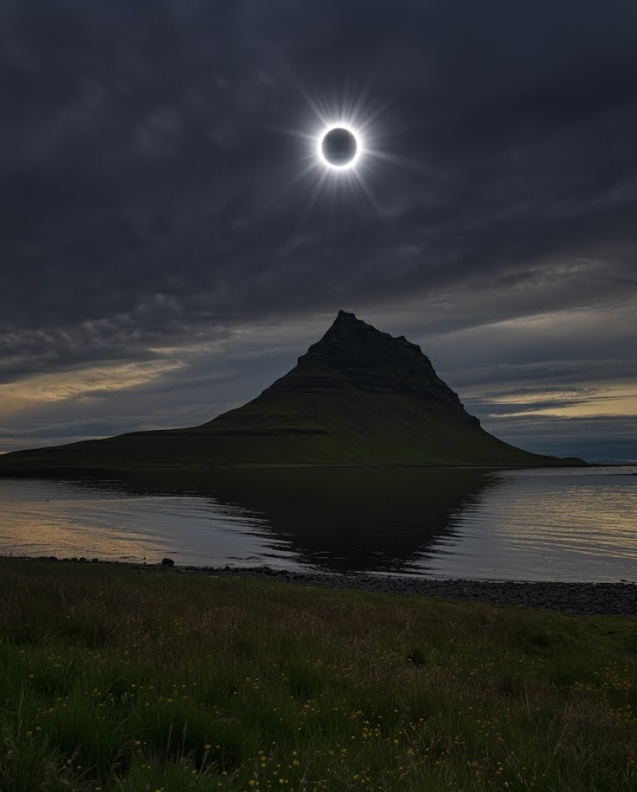
Illustration, not a photograph — this is roughly how it could look over Kirkjufell if the weather plays along.
Reykjanes & Reykjavik – The Convenient Option
- Totality Duration: about 1 minute in central Reykjavík, a few seconds more out at Grótta, and 1 minute 47 seconds at Reykjanestá lighthouse — the longest anywhere on the peninsula
- The Vibe: You can literally watch this from the Grotta Lighthouse or the rooftop of Perlan.
- My Take: The Blue Lagoon sits inside the path too — you can check the exact seconds for any spot on the interactive map at eclipse2026.is. It’s the easiest option if you’re on a short trip, though the “wild” feeling might be dampened a bit by city lights.
The #1 Rule: Mobility is Everything
Here is the number that decides it. Twenty years of Icelandic Met Office data give you roughly a 25% chance of clear or partly clear skies at 18:00 in August. If you can move on the day, that roughly doubles to 50%. That is the entire reason for the car — not comfort, odds.
From about three days out, watch the cloud forecast at icelandatnight.is and the Icelandic Met Office at en.vedur.is, and be ready to drive somewhere else on the morning of the 12th.
I cannot stress this enough: Do not lock yourself into one viewing spot. Icelandic weather in August is “mild” (around 10-15°C), but it’s famously moody. If it’s cloudy in Reykjavik, it might be clear in the Westfjords.
- Get a car. Don’t rely on buses or tours that might get stuck in traffic or clouds.
- The rental situation: anything still available this close to the date will be expensive, and the cheap categories went months ago. Book whatever you can get rather than the perfect vehicle. I would go with Lava Car Rental * for the Westfjords gravel — that comes from comparing companies while planning, not from renting, since my own trip was in a campervan. Use Northbound * to see what is still bookable across providers, and I go through all three in my campervan rental comparison.
What to sort out before the day
- Glasses: Only ISO 12312-2 certified glasses will do, and if you still need a pair, solmyrkvagleraugu.is sells tested CE-certified ones in Iceland. Don’t buy unbranded glasses off a stall on the day. And the bit most people get wrong: you take the glasses off during totality. Those two minutes are the only moment it is safe to look with the naked eye, and with the glasses on you would see nothing at all.
- Traffic: The roads in the Westfjords and Snæfellsnes are narrow. I expect “Iceland-style” traffic jams (which are rare but real). Totality reaches Reykjavík at 17:48 local time. Iceland is on UTC all year round, so that is 19:48 in Berlin. Be parked and settled by early afternoon.
- The “Eclipse Cooling”: When the sun vanishes, the temperature will drop fast — often by 3 to 5 degrees. In Iceland, that can take you from “chilly” to “freezing” in minutes. Bring those extra layers I always talk about.
Linking it to the Big Trip
If you are doing the full 14-day loop — the route I drove is in my Iceland Ring Road Campervan Guide — the timing works well: start in the West and head North after the eclipse. Route 54 gets you from the Snæfellsnes coast back toward the Ring Road without doubling back to the city.
Final Verdict
Even under cloud, the deep twilight rolling across an Icelandic landscape is worth standing outside for. And if the sky opens, you get about two minutes that people plan whole trips around.
One last thing for the day itself: check en.vedur.is in the morning, commit to a spot by lunchtime, and be parked by 16:00. If the cloud has settled on one peninsula, drive to the next one. That is the whole game.
Get an exclusive 5% discount on your booking with Lava Car Rental * using code CREATOR.
Before you go
Planning your own Ring Road trip?
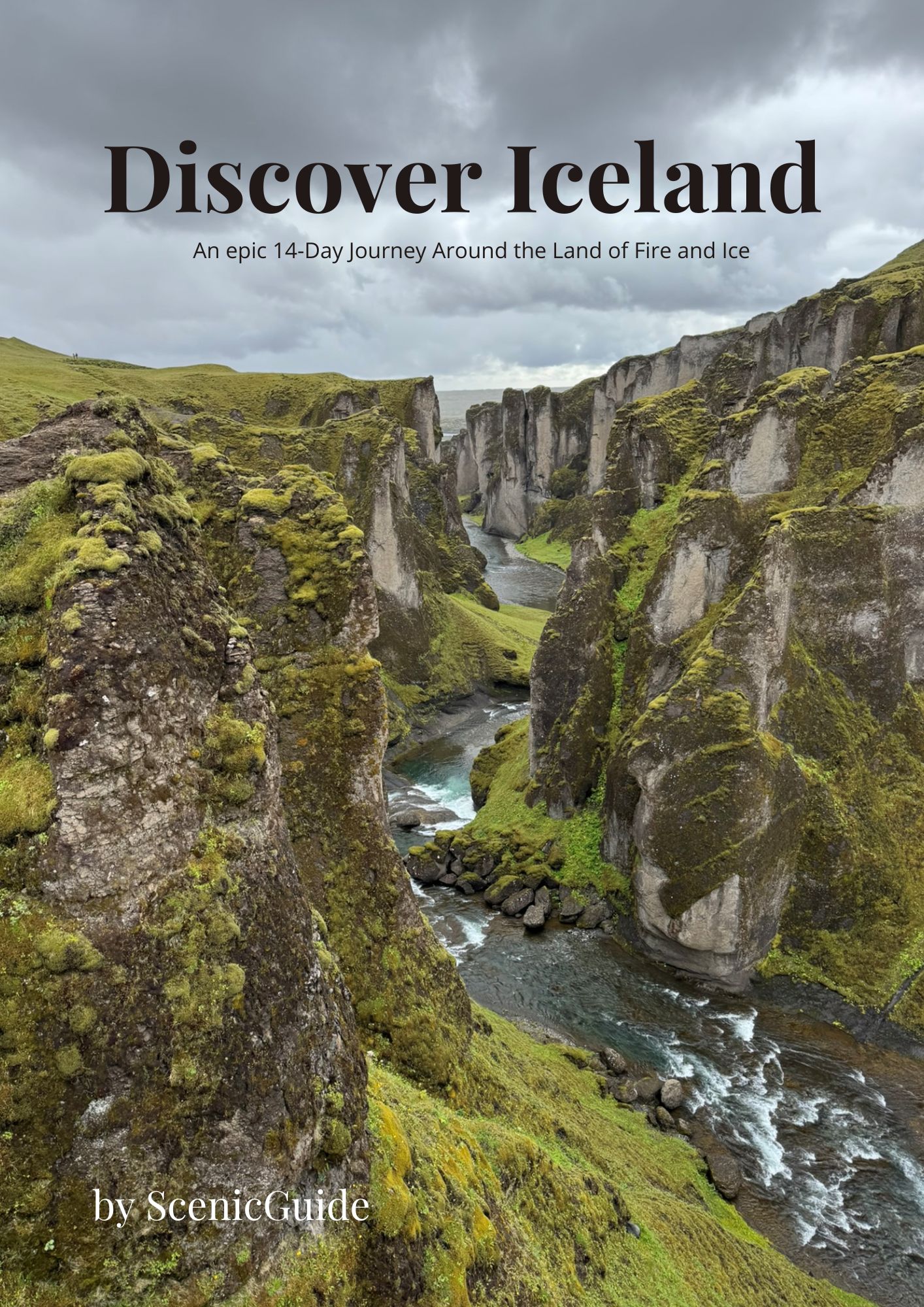
Iceland Ring Road Campervan Guide
My full 14-day route — 2,500 km, every campsite, what I spent, and the detours worth taking. The plan I drove, in one PDF.
How I booked my campervan
I compared three rentals before I chose mine. These are the ones worth checking — Lava gives 5% off with code CREATOR.